USGS is updating how statistical information is delivered. WaterWatch and WaterQualityWatch will be retired around February 24, 2026. Explore alternative tools and share feedback at wdfn@usgs.gov.
|
|
How are these data used?
There are many diverse applications and uses of real-time water-quality data. Real-time and continuous data may be used to:
- improve our understanding of hydrology and water quality and can lead to more effective resource management;
- notify regulatory agencies and the public with information for drinking water treatment and for recreation uses;
- notify water suppliers of changes so they can more efficiently treat drinking water using stream flow data in addition to many in-stream water quality measurements like, water temperature, specific conductance, turbidity, and pH;
- obtain current information on whether river conditions are safe and desirable for a river-rafting trip or a fishing trip (is the water warm or cold or flooding) for recreation;
- assess sustainability of fisheries;
- assess beach recreation quality closures;
- evaluate water-quality standard and criteria attainment;
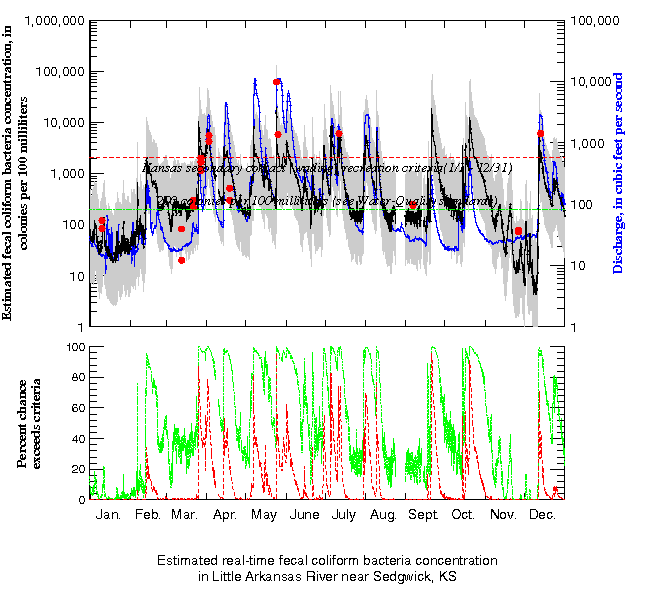
- develop surrogate relations between samples and continuous turbidity measurements to estimate concentrations of indicator bacteria to assess the sanitary quality of water for recreation;
- improve concentration and load estimates with defined uncertainty (based on 8,760 hourly values per year, for example);
- measure seasonal, diel (daily), and event-driven fluctuations to optimize and prioritize sample collection and monitoring;
|